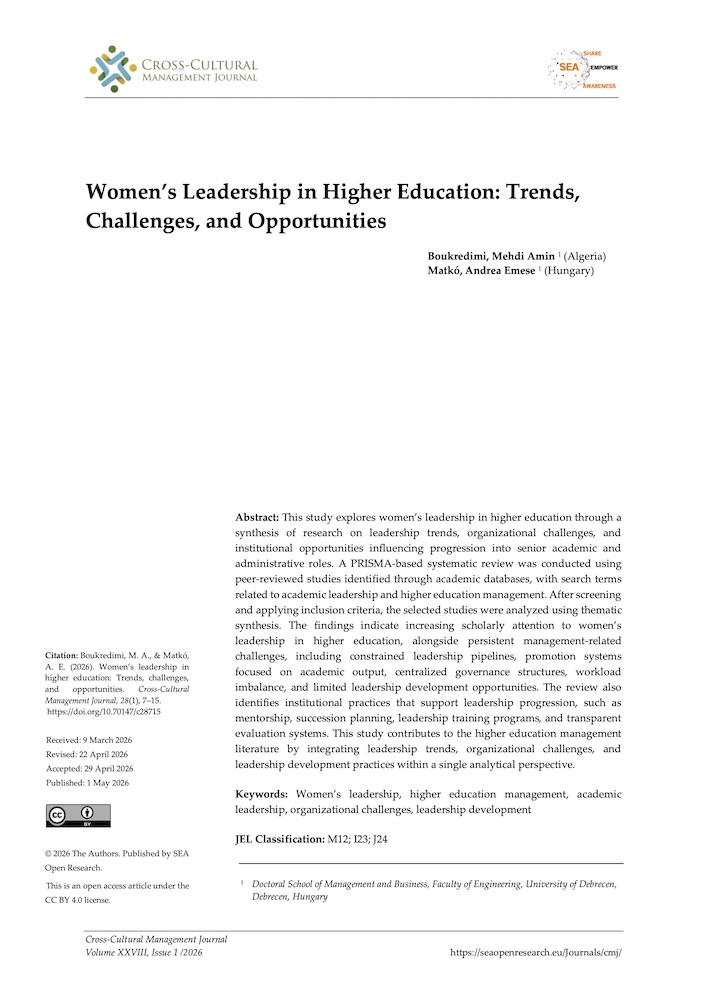

This study explores women’s leadership in higher education through a synthesis of research on leadership trends, organizational challenges, and institutional op-portunities influencing progression into senior academic and administrative roles. A PRISMA-based systematic review was conducted using peer-reviewed studies identified through academic databases, with search terms related to aca-demic leadership and higher education management. After screening and apply-ing inclusion criteria, the selected studies were analyzed using thematic synthe-sis. The findings indicate increasing scholarly attention to women’s leadership in higher education, alongside persistent management-related challenges, including constrained leadership pipelines, promotion systems focused on academic output, centralized governance structures, workload imbalance, and limited leadership development opportunities. The review also identifies institutional practices that support leadership progression, such as mentorship, succession planning, leader-ship training programs, and transparent evaluation systems. This study contrib-utes to the higher education management literature by integrating leadership trends, organizational challenges, and leadership development practices within a single analytical perspective.
- Citation: Boukredimi, M. A., & Matkó, A. E. (2026). Women’s leadership in higher education: Trends, challenges, and opportunities. Cross-Cultural Management Journal, Year (Volume) 28, (1/2026), 7-15. https://doi.org/10.70147/c28715
- Published on: 1 May 2026
- Keywords: Women’s leadership, higher education management, academic leadership, organ-izational challenges, leadership development
- Pages: 7-15
- Received: 9 March 2026
- Final revision and acceptance: 29 April 2026
- Download: PDF
- Doi: https://doi.org/10.70147/c28715
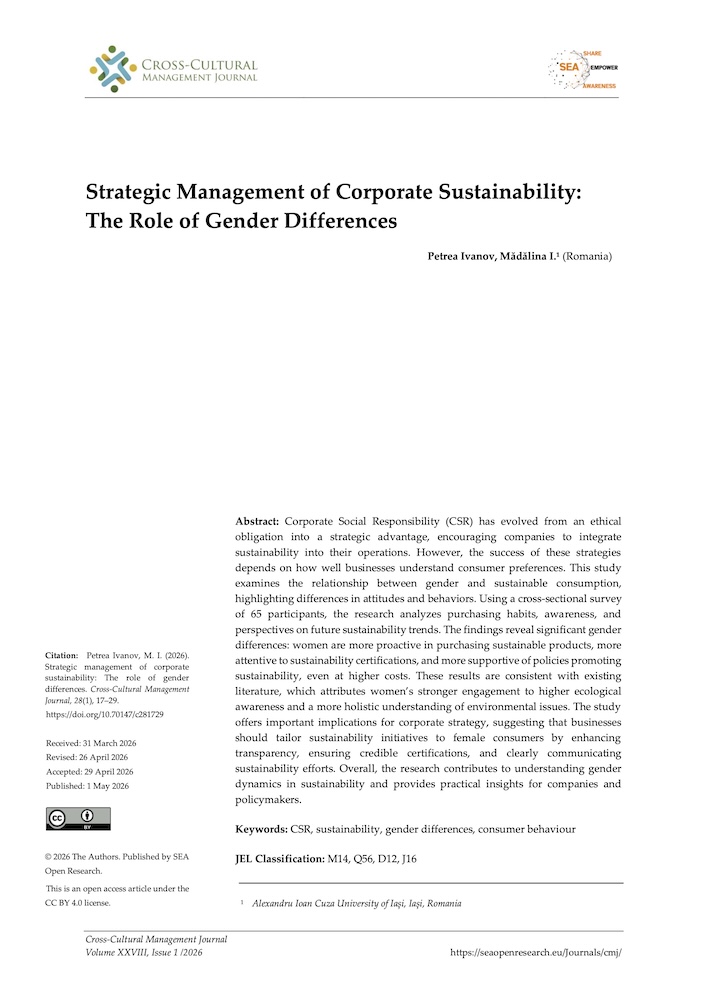
Corporate Social Responsibility (CSR) has evolved from an ethical obligation in-to a strategic advantage, encouraging companies to integrate sustainability into their operations. However, the success of these strategies depends on how well businesses understand consumer preferences. This study examines the relation-ship between gender and sustainable consumption, highlighting differences in at-titudes and behaviors. Using a cross-sectional survey of 65 participants, the re-search analyzes purchasing habits, awareness, and perspectives on future sus-tainability trends. The findings reveal significant gender differences: women are more proactive in purchasing sustainable products, more attentive to sustainabil-ity certifications, and more supportive of policies promoting sustainability, even at higher costs. These results are consistent with existing literature, which attrib-utes women’s stronger engagement to higher ecological awareness and a more holistic understanding of environmental issues. The study offers important im-plications for corporate strategy, suggesting that businesses should tailor sus-tainability initiatives to female consumers by enhancing transparency, ensuring credible certifications, and clearly communicating sustainability efforts. Overall, the research contributes to understanding gender dynamics in sustainability and provides practical insights for companies and policymakers.
- Citation: Petrea Ivanov, M. I. (2026). Strategic management of corporate sustainabili-ty: The role of gender differences. Cross-Cultural Management Journal, Year (Volume) 28, (1/2026), 17-29. https://doi.org/10.70147/c281729
- Published on: 1 May 2026
- Keywords: CSR, sustainability, gender differences, consumer behaviour
- Pages: 17-29
- Received: 31 March 2026
- Final revision and acceptance: 29 April 2026
- Download: PDF
- Doi: https://doi.org/10.70147/c281729
This paper examines the evolution and current limitations of compliance maturi-ty models and develops the conceptual foundations of an integrated approach—the Compliance Governance Maturity Model (CGMM). The study is based on a comprehensive literature review covering the period 2018–2025, focusing on governance-, ethics-, and compliance-oriented models as well as emerging inte-gration approaches (Antonsen & Madsen, 2021; Zammit et al., 2021; Makowicz, 2023). The findings indicate that many existing models primarily emphasize regulatory compliance and control mechanisms, while giving limited attention to critical dimensions such as leadership commitment, ethical culture, and organi-zational integrity. In response, the paper proposes an integrated conceptual framework that reinterprets compliance maturity through the systematic incor-poration of governance and ethical dimensions. The Compliance Governance Ma-turity Model (CGMM) is introduced not as a finalized empirical model, but as a conceptual pre-study aimed at establishing a theoretical foundation for measur-ing organizational integrity. The full model development and empirical valida-tion will be conducted in a subsequent phase of doctoral research.
- Citation: Herman, Z. (2026). Measuring com-pliance maturity and organizational integrity: A conceptual framework for an integrated governance and ethics model. Cross-Cultural Management Journal, Year (Volume) 28, (1/2026), 31-38. https://doi.org/10.70147/c283138
- Published on: 4 May 2026
- Keywords: Compliance maturity, governance, business ethics, organizational integrity, ma-turity models, compliance management, GRC, organizational culture
- Pages: 31-38
- Received: 23 March 2026
- Final revision and acceptance: 2 May 2026
- Download: PDF
- Doi: https://doi.org/10.70147/c283138
The study is devoted to the rethinking of agricultural export strategies in the conditions of instability of international markets from a managerial point of view, taking into account structural shocks, geopolitical risks, logistical gaps and price volatility. The goal is to identify management adaptation mechanisms that increase the sustainability of export activities, strategic flexibility and reliability of management decisions in agribusiness and export-oriented agricultural systems. The analytical framework combines strategic management approaches, export strategy models, risk management tools and supply chain resilience concepts. The methodological basis is formed through a comparative analytical review, structural mapping of instability factors, scenario interpretation and synthesis of modern empirical and institutional data on agrarian trade in crisis conditions, including war and post-pandemic disturbances. The results show that traditional export models, focused mainly on cost minimization and stable logistics routes, are insufficient in conditions of high market turbulence. Effective restructuring of strategies requires diversification of the export portfolio by sales directions, transport corridors and contract formats, dynamic selection of partners and formation of a multi-channel export architecture with builtin risk buffers. The highest adaptability is demonstrated by management systems that integrate operational market analytics, monitoring of regulatory changes and logistical risks into the decision-making circuit. Generalized evidence suggests that companies that apply flexible export management models – modular contract schemes, distributed storage, and combined transportation solutions – provide more stable results in volatile conditions. Strategic flexibility, scenario planning, and a delegated management structure have been proven to increase responsiveness and reduce systemic vulnerability to trade shocks. Institutional interaction with international regulatory regimes, regional trade associations and mechanisms of extraordinary trade facilitation is defined as an important competence. In addition, the study emphasizes that intercultural adaptation and culturally sensitive communication with international partners increase the effectiveness of export coordination, strengthen contractual stability and support long-term presence in diversified agricultural markets. The ability of export-oriented enterprises to integrate cultural and behavioural specifics into managerial decision-making is considered an additional factor of resilience in volatile international environments. The importance of digital traceability tools, analytical risk panels, and data-driven export management is emphasized separately. The practical value of the results lies in the formation of an adaptive management model of the export strategy, which reconciles the diagnosis of instability with the configuration of strategic decisions and supports the increase in the stability of agricultural exports in an unstable international environment.
- Citation: Ulinici, A. (2026). Reconfiguring agricultural export strategies in the context of international market volatili-ty: managerial perspectives. Cross-Cultural Management Journal, Year (Volume) 28, (1/2026), 39-47. https://doi.org/10.70147/c283947
- Published on: 11 May 2026
- Keywords: Agricultural export, reconstruction of the export strategy, volatility of the international market, sustainability of supply chains, risk management, intercultural adaptation
- Pages: 39-47
- Received: 18 March 2026
- Final revision and acceptance: 9 May 2026
- Download: PDF
- Doi: https://doi.org/10.70147/c283947
Sponsorship already operates through reference calls, meetups, calibration sessions, stretch assignments, demo slots and quiet introductions. Because it is informal and opaque, access skews toward the well-connected. This study draws on qualitative interviews with leaders and senior professionals in Israeli high-tech and uses item-level survey data (N = 219) as a supporting complement. The findings map the everyday places where sponsorship lives and show how it can be normalized through light-touch routines that are fair, auditable and hybrid-work friendly. The paper offers a practical taxonomy (access, risk-shielding, credit and visibility, brokerage, capital allocation) and converts each into concrete practices: sponsor-of-record rotations, sponsor minutes in calibration, referral-equity scripts, meetup-sourcing logs, authorship and credit checklists, and demo rotations. Treating sponsorship as organizational infrastructure reduces leakage, improves perceived fairness and makes advancement less dependent on proximity to power.
- Citation: Pinto, Z. (2026). Normalizing sponsorship: The unspoken pathways to advancement in high-tech. Cross-Cultural Management Journal, 28,(1), 49–61. https://doi.org/10.70147/c284961
- Published on: 11 May 2026
- Keywords: Sponsorship, women in technology, career advancement, organizational routines, gender equity, high-tech
- Pages: 49-61
- Received: 22 March 2026
- Final revision and acceptance: 9 May 2026
- Download: PDF
- Doi: https://doi.org/10.70147/c284961
This paper asks how visual education and the consumer's social perception of art photography combine to shape demand in Romania. It focuses on the consumer's side of the market, picking up where two earlier studies left off: the first looked at photographers themselves, the second at the macroeconomic footprint of the field. Thirteen Romanian consumers of art photography were interviewed in depth by telephone. Coding was manual and emergent. Eleven thematic categories surfaced from the transcripts. Schools in Romania teach virtually no photography, and the consequence is observable in the interview data. Content drives purchasing decisions; the photographer's name comes second, or sometimes nowhere at all. Therapeutic, mnemonic, and patronage motives kept appearing where we had not expected them. Willingness to pay was substantially higher than we had assumed before going into the field, with the average minimum standing at 520 RON and the average maximum at 1,460 RON. This is the first qualitative study of the Romanian art photography market built from the consumer's perspective. It also serves as the empirical scaffolding for a forthcoming quantitative survey.
- Citation: Fusu, G. (2026). The role of visual education and social perception in shaping the art photography market: a qualitative analysis. Cross-Cultural Management Journal, 28(1), 63-74. https://doi.org/10.70147/c286374
- Published on: 10 June 2026
- Keywords: Visual education; social perception of art; art photography consumption; consumer motivation; Romanian art market; thematic analysis
- Pages: 63-74
- Received: 26 April 2026
- Final revision and acceptance: 9 June 2026
- Download: PDF
- Doi: https://doi.org/10.70147/c286374
The aim of this study is to provide an overview of the infrastructure conditions of the digital economy, with particular emphasis on the undersea fiber-optic cable networks that support global data flows, the economic impacts of broadband internet, and the regional and corporate dimensions of the digital divide observable within the European Union. Today, digital infrastructure cannot be viewed merely as a technological foundation but also as a fundamental prerequisite for economic growth, productivity, employment, business adaptability, and social participation. According to the international literature, broadband internet access is positively correlated with GDP growth, productivity, business dynamism, and economic resilience to crises; however, the intensity of these effects may vary considerably by country, region, firm size, and by demand-side adaptation. The study emphasizes substantial convergence in internet access within the European Union, particularly in Eastern and Southeastern European member states, however, urban–rural disparities, differences by firm size, and access to higher-quality connections continue to indicate structural inequalities. The development of the digital economy therefore cannot be understood solely through the lens of infrastructure availability; it is necessary to also consider actual usage, digital skills, business adaptation, and the socio-economic environment.
- Citation: Arany, L., Popovics, P. A. (2026). The infrastructure framework of the digital economy: broadband access, economic resilience, and the digital divide in the European Union. Cross-Cultural Management Journal, 28(1), 75-88. https://doi.org/10.70147/c287588
- Published on: 10 June 2026
- Keywords: Digital economy, digital infrastructure, broadband internet, digital divide, digital convergence, economic resilience
- Pages: 75-88
- Received: 23 April 2026
- Final revision and acceptance: 9 June 2026
- Download: PDF
- Doi: https://doi.org/10.70147/c287588
This paper examines the shift from work-life balance rhetoric to work-life integration practice in high-tech, using Israeli firms closely coupled to United States time zones as a critical case. Drawing on a mixed-methods design that combines nineteen semi-structured interviews with engineers, product leaders, recruiters, and executives with survey data from 219 women across the Israeli high-tech sector, the study synthesizes classic lenses of work-family conflict and enrichment, boundary fit, and job demands-resources theory with current organizational realities such as hybrid work and return-to-office policies. The analysis identifies a practical core to integration: temporal equity. Outcomes depend less on total hours and more on four conditions operating together: usable schedule control, boundary fit between preferences and team routines, contained connectivity load so that evenings do not become shadow stand-ups, and credit decoupled from live presence through artifacts such as recorded demos, written kudos, and sponsor-of-record practices. Interviews reveal how Israeli-U.S. coordination creates a recurrent time-zone tax, how mental load extends beyond leave into daily logistics, and how simple routines (protected family bands with written exceptions, mirrored ceremonies across time zones, rota audits for late hours) reduce friction without slowing delivery. Men's planned co-ownership of care appears as a small but notable cultural shift. Quantitative data triangulate these themes: 72% of surveyed women cite work-life time constraints as the primary barrier preventing participation in professional meetups, and 36% report that personal obligations have prevented them from pursuing advancement opportunities. The paper contributes a clear, practice-oriented temporal equity lens on integration and specifies low-cost routines that teams can adopt. Managing when work happens and how recognition is earned, rather than only where work occurs, enables the same total hours to sustain careers without taxing family life.
- Citation: Pinto, Z. (2026). From work-life balance to integration: shifting perceptions in high-tech. Cross-Cultural Management Journal, 28,(1), 88–99. https://doi.org/10.70147/c288889
- Published on: 10 June 2026
- Keywords: Work-life integration, work-life balance, women in technology, hybrid work, temporal equity
- Pages: 89-99
- Received: 9 April 2026
- Final revision and acceptance: 9 June 2026
- Download: PDF
- Doi: https://doi.org/10.70147/c288999
This paper presents the qualitative findings that emerged from a mixed-methods study examining job satisfaction, work motivation, organizational commitment, and internal marketing perceptions among nursing staff and managers in an Israeli psychiatric hospital. Content analysis that was employed on the data collected through semi-structured in-depth interviews from eleven nursing staff members and four senior nurse managers, identified four overarching themes, i.e., job satisfaction, motivation, organizational commitment, and internal marketing as well as twelve related categories. Findings indicate that chronic workload, burnout, and insufficient recognition are the primary drivers of job dissatisfaction, while a sense of mission, curiosity, patient connection, and work enjoyment constitute core motivational resources. Organizational commitment is sustained through belonging and mutual team support, whereas internal marketing practices, particularly open communication, attentiveness, and individualized reward and recognition emerge as pivotal organizational levers. A convergence between nursing staff and managerial perspectives validates the identified themes. Evidence-based recommendations for healthcare managers and policy-makers are advanced, with implications for the retention and engagement of Generation Y and Z nursing staff in mental health settings.
- Citation: Hanukayev, E. (2026). Internal marketing, job satisfaction, and nursing motivation in psychiatric settings: A qualitative study. Cross-Cultural Management Journal, 28,(1), 101–112. https://doi.org/10.70147/c28101112
- Published on: 31 July 2026
- Keywords: Mental health nursing, job satisfaction, motivation, organizational commitment, internal marketing, burnout, generation Y and generation Z
- Pages: 101-112
- Received: 9 July 2026
- Final revision and acceptance: 29 July 2026
- Download: PDF
- Doi: https://doi.org/10.70147/c28101112
The paper explores consumer behavior characteristics and cultural patterns in Israel’s public housing market, focusing on the tenants’ exercise of their purchase rights. Public housing is a social safety net and a fundamental right for disadvantaged populations, providing shelter and the potential for social and economic mobility. Although the Public Housing Law in Israel was intended to enable eligible tenants to purchase their apartments at a significant discount to help them break out of the poverty cycle, in practice, many fail to exercise this right. The study’s significance lies in its analysis of purchasing barriers through cultural and behavioral lenses, with a view to empowering vulnerable populations to exercise their rights. The quantitative research sought to examine relationships between public housing consumer characteristics and purchasing intentions. The findings indicate a market failure characterized by a gap between legislative intent and reality. While Socio-demographic variables did not constitute a significant barrier to consumer behavior, a correlation was found between literacy gaps, the absence of external professional and financial guidance, and the reluctance to initiate the purchasing process. The study found that to motivate purchasing intentions, government representatives must integrate cultural competence, proactive information, accessibility, and tailored support systems into the process.
- Citation: Magar, A. (2026). Consumer behavior characteristics and cultural aspects in marketing Israel’s public housing. Cross-Cultural Management Journal, 28,(2), 117-132. https://doi.org/10.70147/c28117132
- Published on: 12 June 2026
- Keywords: Public housing, consumer behavior, purchase rights, supply and demand, cultural competence
- Pages: 117-132
- Received: 2 May 2026
- Final revision and acceptance: 10 June 2026
- Download: PDF
- Doi: https://doi.org/10.70147/c28117132
Burnout among mental health nursing staff represents a critical and underexamined challenge with far-reaching implications for both healthcare personnel and patient outcomes. This article undertakes a systematic review of the organizational, environmental, and personal determinants of burnout within psychiatric nursing contexts, situating the analysis within established occupational health frameworks and current empirical literature. Drawing on Maslach’s conceptualization of burnout, the Conservation of Resources model, and generational workforce theory, the article examines how structural deficits—including chronic understaffing, inadequate professional autonomy, high emotional labor demands, and misaligned organizational culture—interact with individual vulnerability factors to produce and perpetuate burnout. Special attention is given to the distinct pressures inherent in acute inpatient psychiatric settings, where staff are routinely exposed to patient aggression, complex ethical dilemmas, and unpredictable clinical demands. The article further explores generational differences in work values and coping styles among Generation Y and Z nursing staff, and discusses evidence-based strategies for burnout prevention at the individual, team, and institutional levels. The discussion culminates in a set of policy-oriented recommendations aimed at fostering sustainable motivation, psychological resilience, and high-quality care delivery within mental health nursing workforces.
- Citation: Hanukayev, E., & Manolică, A. (2026). Burnout in mental healthcare systems: A multidimensional perspective. Cross-Cultural Management Journal, 28(2), 133–140. https://doi.org/10.70147/c28133140
- Published on: 20 July 2026
- Keywords: Mental health nursing, organizational culture, occupational stress, Generation Y, Generation Z, resilience
- Pages: 133–140
- Received: 16 June 2026
- Final revision: 9 July 2026
- Accepted: 12 July 2026
- Download: PDF
- Doi: https://doi.org/10.70147/c28133140
This study examines the historical and conceptual relationship between corporate social responsibility (CSR) and corporate moral responsibility (CMR), two distinct but unevenly developed concepts referring to corporate responsibilities beyond purely economic concerns. Drawing on key CSR and CMR literature, the paper traces the evolution of both concepts from early formulations to contemporary debates, highlighting their different trajectories and shifting relationship. The analysis shows that CSR became a widely developed field of inquiry, while CMR remained more narrowly focused on debates around corporate moral agency. It also indicates that CSR and CMR were initially treated largely separately, before being examined together more explicitly from the 2000s onward. Three main directions can be identified in this later literature: (1) treating CSR and CMR as distinct constructs, (2) incorporating moral responsibility into CSR, and (3) comparing CSR and CMR as related or potentially competing frameworks. The paper contributes to the literature by offering a conceptual overview of how the relationship between CSR and CMR has been articulated and by clarifying the main points of connection, overlap, and divergence between the two concepts.
- Citation: Zaharia, M., & Horodnic, I. A. (2026). Corporate social responsibility and corporate moral responsibility: Historical trajectories and conceptual boundaries. Cross-Cultural Management Journal, 28(2), 141–152. https://doi.org/10.70147/c28141152
- Published on: 20 July 2026
- Keywords: Corporate social responsibility, corporate moral responsibility, corporate moral agency, business ethics
- Pages: 141–152
- Received: 19 June 2026
- Final revision: 12 July 2026
- Accepted: 15 July 2026
- Download: PDF
- Doi: https://doi.org/10.70147/c28141152
Workforce diversity has become commonplace, yet the mere presence of differences does not ensure equitable participation or equal access to opportunities and decision-making. Research on organizational inclusion has expanded, but what is studied and how it is studied vary across disciplinary fields, leaving a fragmented picture. This article proposes a preliminary conceptual model, CLAR, that treats inclusion as a complex, ongoing process. The components were derived by grouping the processes identified in theoretical and empirical contributions according to the role each plays in producing access, participation, and belonging at the micro, meso, and macro levels. Organizational culture provides the context within which the identified components operate and is, in turn, influenced by them, while inclusive leadership helps activate the functions of these components. Several organizational practices are also recommended. The main contribution is an integrative multi-level model that connects perspectives usually analyzed separately.
- Citation: Onea (Neculăesei), A.-N. (2026). Organizational inclusion as a multi-level process: A conceptual synthesis of access, participation and belonging. Cross-Cultural Management Journal, 28(2), 153–162. https://doi.org/10.70147/c28153162
- Published on: 29 July 2026
- Keywords: Organizational inclusion, diversity management, multi-level model, belongingness, inclusion climate, inclusive leadership
- Pages: 153–162
- Received: 29 May 2026
- Final revision: 12 July 2026
- Accepted: 20 July 2026
- Download: PDF
- Doi: https://doi.org/10.70147/c28153162
Algeria's long-standing dependence on hydrocarbon revenues has made economic diversification a national priority, and tourism has emerged as a strategic alternative. This conceptual paper develops an integrative framework linking the internationalization of tourism small and medium-sized enterprises (SMEs) to broader economic transformation in resource-dependent economies. Drawing on the resource-based view, the dynamic capabilities perspective, the Uppsala model, the network approach, and institutional theory, the paper synthesizes international and Algerian-specific literatures. The framework proposes four antecedent clusters — intangible resources, digital and dynamic capabilities, network embeddedness, and institutional conditions — that shape internationalization trajectories, which in turn drive three economic transformation outcomes: productive diversification, foreign exchange and employment generation, and knowledge spillovers. Eight testable propositions and a multi-method empirical agenda are advanced, contributing to international business, tourism management, and development economics scholarship.
- Citation: Benrebiha, M., & Zerrouki, D. (2026). The role of tourism SMEs' internationalization in achieving economic transformation: A conceptual framework from the Algerian context. Cross-Cultural Management Journal, 28(2), 163–173. https://doi.org/10.70147/c28163173
- Published on: 7 September 2026
- Keywords: Tourism SMEs; internationalization; economic transformation; dynamic capabilities; Algeria
- Pages: 163–173
- Received: 6 August 2026
- Final revision: 4 September 2026
- Accepted: 5 September 2026
- Download: PDF
- Doi: https://doi.org/10.70147/c28163173
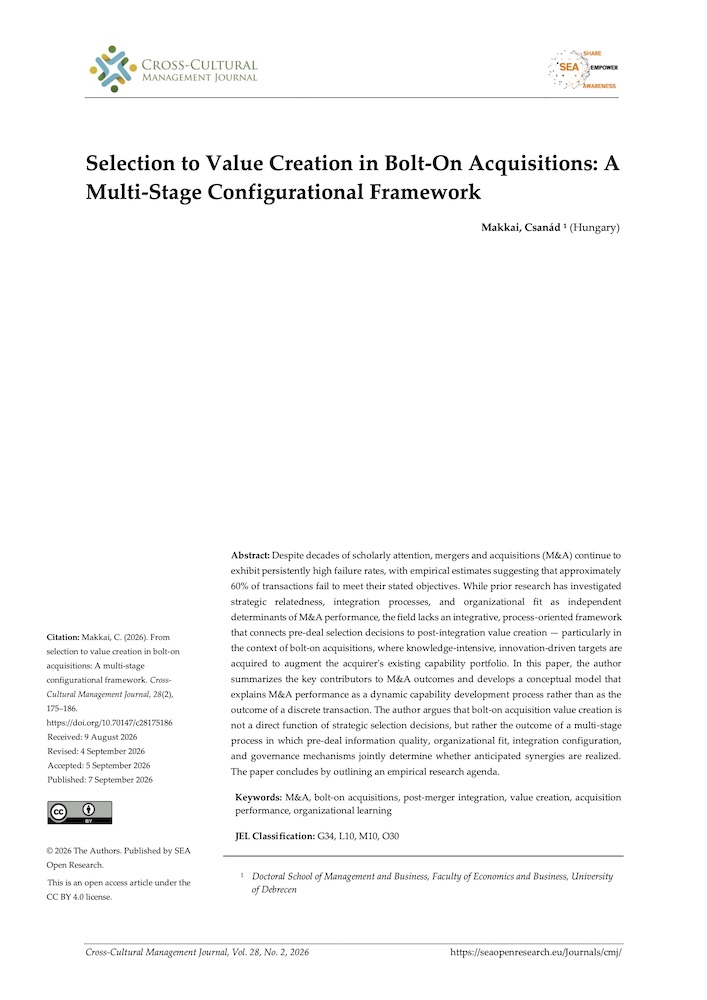
Despite decades of scholarly attention, mergers and acquisitions (M&A) continue to exhibit persistently high failure rates, with empirical estimates suggesting that approximately 60% of transactions fail to meet their stated objectives. While prior research has investigated strategic relatedness, integration processes, and organizational fit as independent determinants of M&A performance, the field lacks an integrative, process-oriented framework that connects pre-deal selection decisions to post-integration value creation — particularly in the context of bolt-on acquisitions, where knowledge-intensive, innovation-driven targets are acquired to augment the acquirer's existing capability portfolio. In this paper, the author summarizes the key contributors to M&A outcomes and develops a conceptual model that explains M&A performance as a dynamic capability development process rather than as the outcome of a discrete transaction. The author argues that bolt-on acquisition value creation is not a direct function of strategic selection decisions, but rather the outcome of a multi-stage process in which pre-deal information quality, organizational fit, integration configuration, and governance mechanisms jointly determine whether anticipated synergies are realized. The paper concludes by outlining an empirical research agenda.
- Citation: Makkai, C. (2026). From selection to value creation in bolt-on acquisitions: A multi-stage configurational framework. Cross-Cultural Management Journal, 28(2), 175–186. https://doi.org/10.70147/c28175186
- Published on: 7 September 2026
- Keywords: M&A, bolt-on acquisitions, post-merger integration, value creation, acquisition performance, organizational learning
- Pages: 175–186
- Received: 9 August 2026
- Final revision: 4 September 2026
- Accepted: 5 September 2026
- Download: PDF
- Doi: https://doi.org/10.70147/c28175186
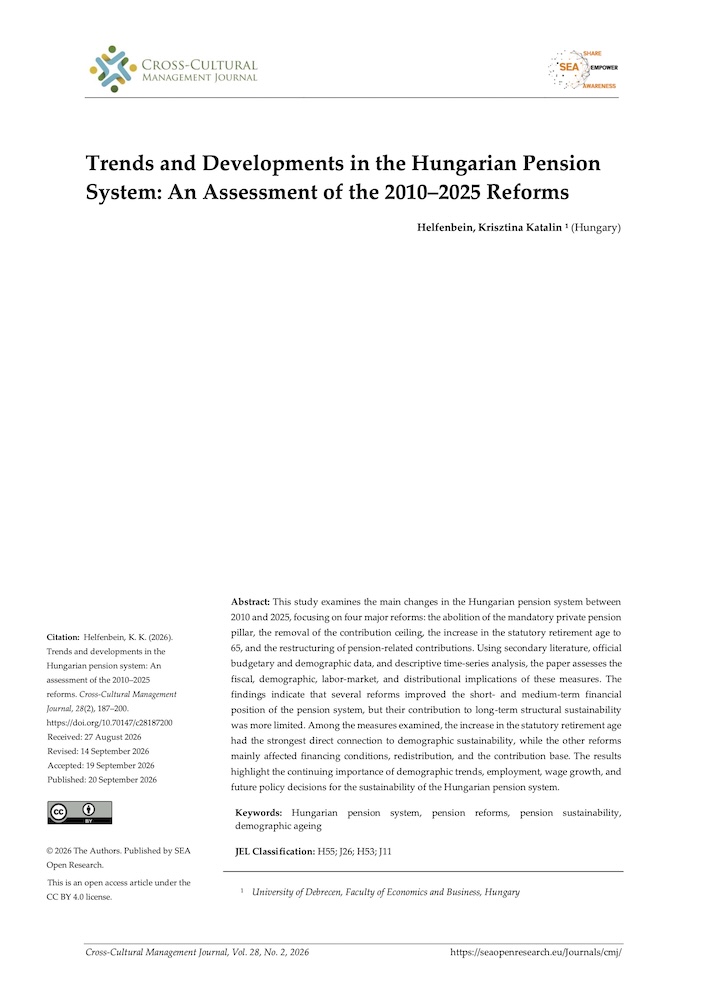
This study examines the main changes in the Hungarian pension system between 2010 and 2025, focusing on four major reforms: the abolition of the mandatory private pension pillar, the removal of the contribution ceiling, the increase in the statutory retirement age to 65, and the restructuring of pension-related contributions. Using secondary literature, official budgetary and demographic data, and descriptive time-series analysis, the paper assesses the fiscal, demographic, labor-market, and distributional implications of these measures. The findings indicate that several reforms improved the short- and medium-term financial position of the pension system, but their contribution to long-term structural sustainability was more limited. Among the measures examined, the increase in the statutory retirement age had the strongest direct connection to demographic sustainability, while the other reforms mainly affected financing conditions, redistribution, and the contribution base. The results highlight the continuing importance of demographic trends, employment, wage growth, and future policy decisions for the sustainability of the Hungarian pension system.
- Citation: Helfenbein, K. K. (2026). Trends and developments in the Hungarian pension system: An assessment of the 2010–2025 reforms. Cross-Cultural Management Journal, 28(2), 187–200. https://doi.org/10.70147/c28187200
- Published on: 20 September 2026
- Keywords: Hungarian pension system, pension reforms, pension sustainability, demographic ageing
- Pages: 187–1200
- Received: 27 August 2026
- Final revision: 14 September 2026
- Accepted: 19 September 2026
- Download: PDF
- Doi: https://doi.org/10.70147/c28187200
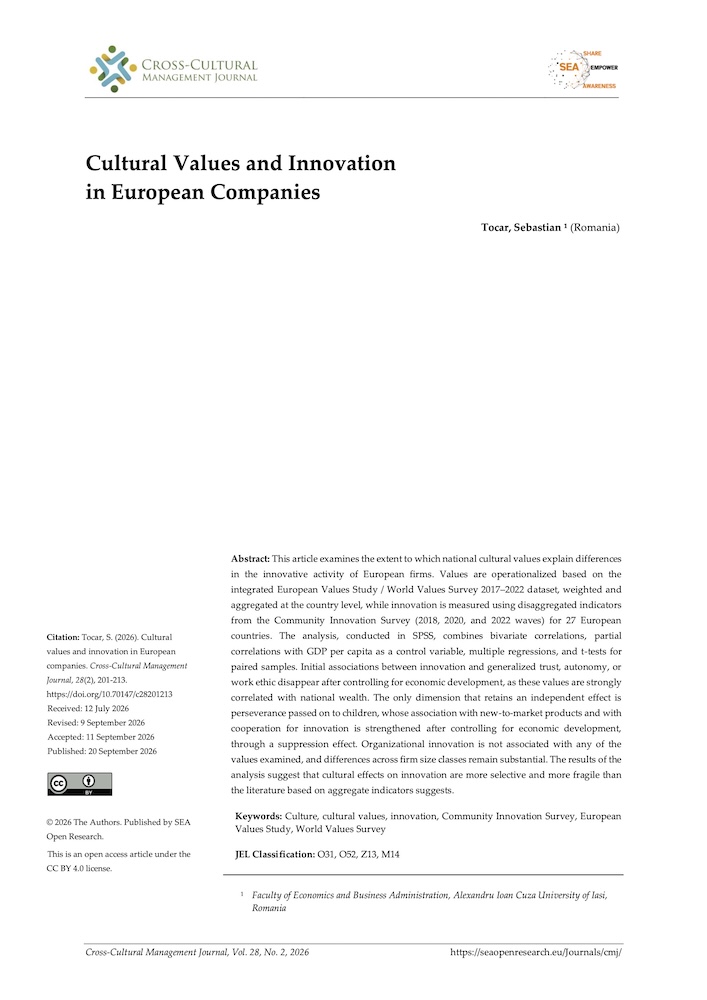
This article examines the extent to which national cultural values explain differences in the innovative activity of European firms. Values are operationalized based on the integrated European Values Study / World Values Survey 2017–2022 dataset, weighted and aggregated at the country level, while innovation is measured using disaggregated indicators from the Community Innovation Survey (2018, 2020, and 2022 waves) for 27 European countries. The analysis, conducted in SPSS, combines bivariate correlations, partial correlations with GDP per capita as a control variable, multiple regressions, and t-tests for paired samples. Initial associations between innovation and generalized trust, autonomy, or work ethic disappear after controlling for economic development, as these values are strongly correlated with national wealth. The only dimension that retains an independent effect is perseverance passed on to children, whose association with new-to-market products and with cooperation for innovation is strengthened after controlling for economic development, through a suppression effect. Organizational innovation is not associated with any of the values examined, and differences across firm size classes remain substantial. The results of the analysis suggest that cultural effects on innovation are more selective and more fragile than the literature based on aggregate indicators suggests.
- Citation: Tocar, S. (2026). Cultural values and innovation in European companies. Cross-Cultural Management Journal, 28(2), 201–213. https://doi.org/10.70147/c28201213
- Published on: 20 September 2026
- Keywords: Culture, cultural values, innovation, Community Innovation Survey, European Values Study, World Values Survey
- Pages: 201-213
- Received: 12 July 2026
- Final revision: 9 September 2026
- Accepted: 11 September 2026
- Download: PDF
- Doi: https://doi.org/10.70147/c28201213
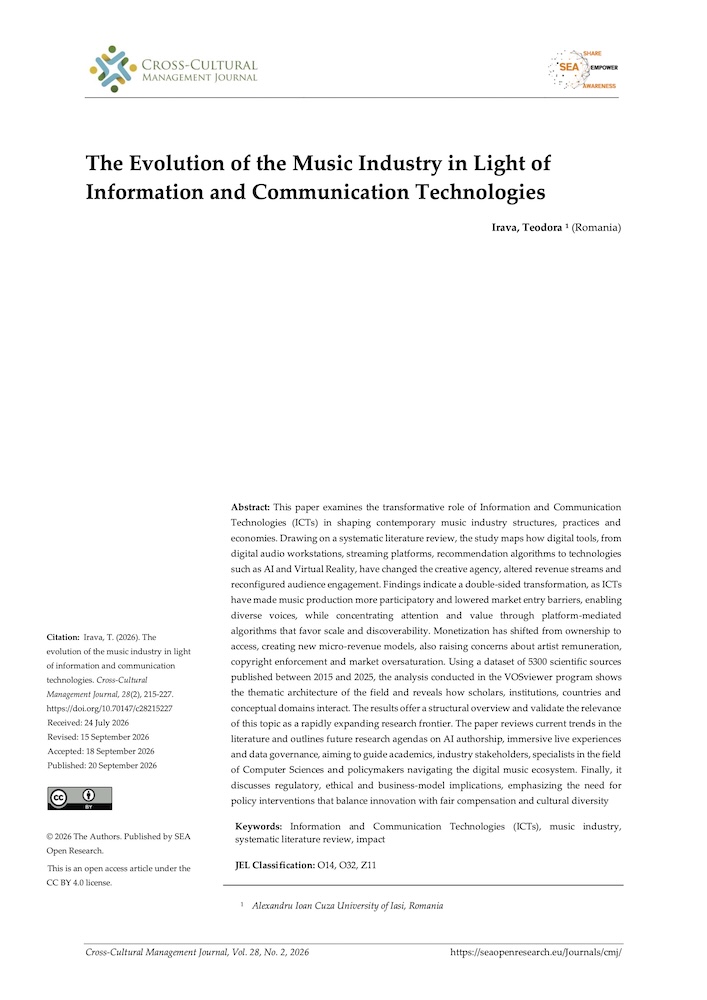
This paper examines the transformative role of Information and Communication Technologies (ICTs) in shaping contemporary music industry structures, practices and economies. Drawing on a systematic literature review, the study maps how digital tools, from digital audio workstations, streaming platforms, recommendation algorithms to technologies such as AI and Virtual Reality, have changed the creative agency, altered revenue streams and reconfigured audience engagement. Findings indicate a double-sided transformation, as ICTs have made music production more participatory and lowered market entry barriers, enabling diverse voices, while concentrating attention and value through platform-mediated algorithms that favor scale and discoverability. Monetization has shifted from ownership to access, creating new micro-revenue models, also raising concerns about artist remuneration, copyright enforcement and market oversaturation. Using a dataset of 5300 scientific sources published between 2015 and 2025, the analysis conducted in the VOSviewer program shows the thematic architecture of the field and reveals how scholars, institutions, countries and conceptual domains interact. The results offer a structural overview and validate the relevance of this topic as a rapidly expanding research frontier. The paper reviews current trends in the literature and outlines future research agendas on AI authorship, immersive live experiences and data governance, aiming to guide academics, industry stakeholders, specialists in the field of Computer Sciences and policymakers navigating the digital music ecosystem. Finally, it discusses regulatory, ethical and business-model implications, emphasizing the need for policy interventions that balance innovation with fair compensation and cultural diversity.
- Citation: Irava, T. (2026). The evolution of the music industry in light of information and communication technologies. Cross-Cultural Management Journal, 28(2), 215–227. https://doi.org/10.70147/c28215227
- Published on: 20 September 2026
- Keywords: Information and Communication Technologies (ICTs), music industry, systematic literature review, impact
- Pages: 215-227
- Received: 24 July 2026
- Final revision: 15 September 2026
- Accepted: 18 September 2026
- Download: PDF
- Doi: https://doi.org/10.70147/c28215227